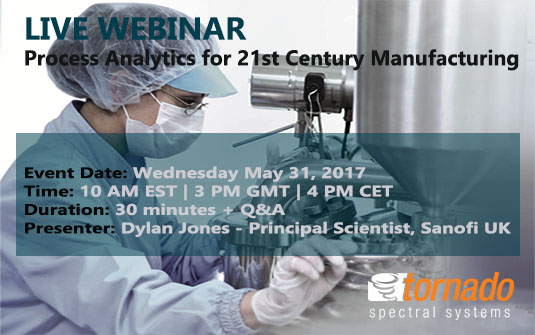
Webinar – Process Analytics for 21st Century Manufacturing

LIVE WEBINAR: Wednesday May 31st, 2017
To register, please click on the image below!

Key Learning Objectives
  • Understand when we need process analytics in advanced manufacturing
  • Understand some of the challenges in implementing process analytics successfully
  • Understand the particular benefits in using Raman spectroscopy
Who Should Attend

Both new and experienced Raman users, including scientists and researchers from material sciences, life sciences, pharma, and other fields that use Raman spectroscopy.

Webinar: How Extrusion Conditions Influence the Properties of Starch Compounds

Mar 01, 2017 – Mar 01, 2017

You can create better starch compounds by controlling extrusion conditions for food products. This webinar explains how to improve the quality of your final food product by managing the influence of twin-screw extrusion on various product properties.

Background: Starch is a base material for many food products: snacks, cereals, pet food, etc. Yet the gelation process is complex and shaped by many different variables. Processing starch with twin-screw extrusion offers a great flexibility in process design and the opportunity to positively influence products derived from it.

Benefits: Learn how to manipulate processing variables to design a starch matrix that delivers the texture, stability and processability you want. The webinar covers how to choose extruder parameters such as screw set-up, processing temperature and liquid-to-solid ratio to create the desired final food properties. Then see how oscillatory rheometry can deliver the precise analysis needed to ensure a high-quality end product.

Duration: 28 min

Complete the form to view this webinar today!

Please correct the errors and send your information again.

I’d like to speak with a sales representative.

I’d like a product demo.

I’d like a product quote.

Contact Us

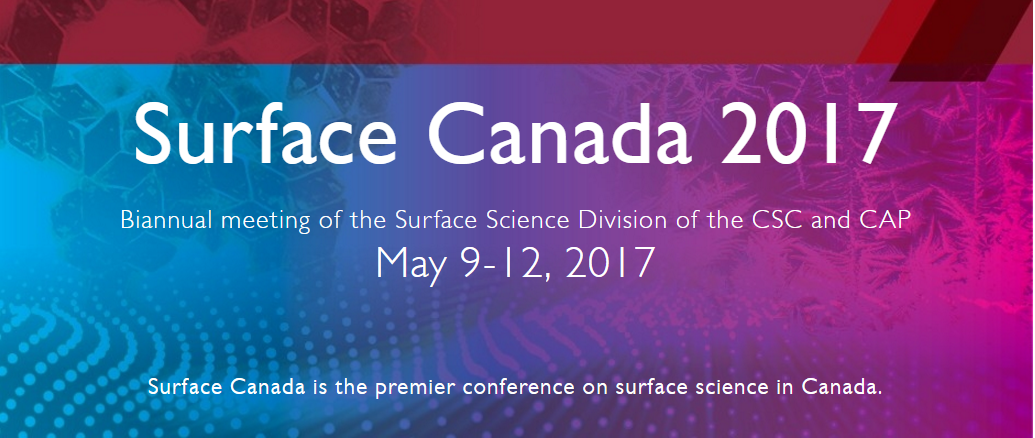
Surface Canada 2017-Biannual meeting of the Surface Science Division of the CSC and CAP

Surface Canada 2017
Surface Canada is interdisciplinary in nature, and will bring together world-recognized experts and young researchers from a broad spectrum of disciplines including physics, chemistry, material science engineering and many other fields and will cover a wide range of topics pertinent to surface science, from the fundamental to the applied.

Surface Canada will provide an avenue for scientists from academic, industrial and government labs to meet and define the important problems in the field and to highlight emerging opportunities and potential impact to our society.

Keynote speaker

Paul Weiss, UCLA  

Invited speakers

  • Geraldine Bazuin, Université de Montréal: Diverse 2D Patterns in Block Copolymer Thin Films Using Dip-Coating, Supramolecular Strategies and Light
  • Julianne Gibbs-Davis, University of Alberta: Seeing the Electric Double Layer at Silica/Aqueous Interfaces with Nonlinear Optical Spectroscopy
  • Tricia Carmichael, University of Windsor: The Best of Both Worlds: Layered Composites of Butyl Rubber and PDMS for Stretchable and Impermeable Electronics
  • Emanuele Orgiu, INRS: Rise of Periodic Potentials in Hybrid Graphene/Supramolecular Lattice van der Waals Heterostructures

Organizing committee

  • Christine DeWolf, Concordia University
  • Antonella Badia, Université de Montréal
  • Peter Gruetter, McGill University
  • Dmitrii Perepichka, McGill University


Conference topics

  • Thin films, surface functionalization and self-assembly
  • Solid and liquid interfaces
  • Nanomaterials and nanopatterned surfaces
  • Surface analysis techniques
  • Catalysts
  • Sensors
  • Polymers at interfaces

Important dates

  • Abstract submission and registration begins: February 25, 2017
  • Abstract submission ends: March 31, 2017
  • Acceptance notification: April 7, 2017
  • Early registration ends: April 14, 2017
Spectra Research Corporation

5805 Kennedy Rd.,

Mississauga ON, L4Z 2G3

TEL: 905 890 2010

FAX: 905 890 1959


Will be exhibiting at Surface Canada 2017.

Spectra Research Corporation (SRC) offers a range of innovative high-quality scientific products and laboratory services to industrial and scientific markets throughout Canada.

If you require exceptional laboratory services and support, our technical expertise and industry knowledge allows us to provide service and training for all the products we represent.

Established in 1993, SRC is a subsidiary of Allan Crawford Associates (ACA), one of Canada’s largest distributors of electronic components, test equipment and integrated networking solutions.

3rd Annual Meeting of the Biophysical Society of Canada

[layerslider id=”4″]

Registration

All fees are in Canadian dollars. Please register before April 3, 2017 to enjoy early fees. Current BSC members are entitled to discounted registration prices for the annual meetingclick here to join now!

Early Registration Fees Available Until April 3, 2017

Late Registration Fees – Begins April 4, 2017

Spectra Research Corporation

5805 Kennedy Rd.,

Mississauga ON, L4Z 2G3

TEL: 905 890 2010

FAX: 905 890 1959


Will be exhibiting at Biophysical Society of Canada Shows

Spectra Research Corporation (SRC) offers a range of innovative high-quality scientific products and laboratory services to industrial and scientific markets throughout Canada.

If you require exceptional laboratory services and support, our technical expertise and industry knowledge allows us to provide service and training for all the products we represent.

Established in 1993, SRC is a subsidiary of Allan Crawford Associates (ACA), one of Canada’s largest distributors of electronic components, test equipment and integrated networking solutions.


100th Canadian Chemistry Conference and Exhibition

Registration is now open 

To register on-line:
CSC2017 Online Individual Registration

To register by mail or fax, download:

CSC2017 Individual Registration Form (pdf)

Spectra Research Corporation

5805 Kennedy Rd.,

Mississauga ON, L4Z 2G3

TEL: 905 890 2010

FAX: 905 890 1959


Will be exhibiting at CSC2017, Toronto.

Spectra Research Corporation (SRC) offers a range of innovative high-quality scientific products and laboratory services to industrial and scientific markets throughout Canada.

If you require exceptional laboratory services and support, our technical expertise and industry knowledge allows us to provide service and training for all the products we represent.

Established in 1993, SRC is a subsidiary of Allan Crawford Associates (ACA), one of Canada’s largest distributors of electronic components, test equipment and integrated networking solutions.

Herzan MicroDamp Series Vibration Isolators


herzan-microdamp-series-vibration-isolatorsOVERVIEW

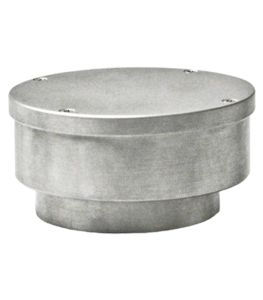
The MicroDamp Series vibration isolators are an affordable and effective solution, optimized to any instrument’s weight and dimension profile. Utilizing a polished aluminum housing and highly damped composite material, the MicroDamp Series provides a cost-effective solution for instruments experiencing broad frequency vibration noise within their lab environment.

request-quote-button

PRODUCT HIGHLIGHTS

  • Affordable and efficient vibration isolation
  • Minimal amplitude within resonant frequency
  • Compact, modular form factor
  • Wide range of supported instrument weights
  • Easy to integrate into existing instrument setups
  • No air or electricity required
  • Light-weight and easy to install/use

APPLICATIONS

  • Optical Microscopy
  • Interferometry
  • Profilometry
  • Microbalanace Systems
  • Precision Inspection Stations
  • Highly Sensitive Lab Equipment
  • And More!


image16

SELECTION GUIDE

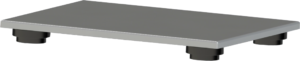
images17The MicroDamp series often utilizes three to four isolators within a vibration isolation platform, depending on the supported instrument’s dimension profile and overall weight distribution. When paired with a damped top plate (i.e. granite, aluminum, breadboard, etc.), the MicroDamp Series becomes a complete solution for instruments requiring a stable and reliable vibration isolation platform.

To determine the correct isolator configuration for your instrument, review the MicroDamp models below and locate the model able to sufficiently support the weight of your instrument.

Please note: the values listed below are for individual isolators only. To correctly select the relevant model for your instrument, multiply the minimum/maximum load capacities by three to determine the total minimum/maximum load capacities. Your instrument must fall within this range to receive optimal vibration isolation performance. If your instrument’s weight does not fall within this range, multiply the minimum/maximum load capacities by a larger number (>3) until your instrument falls within range.

HELPFUL TIP

For further instruction on the correct configuration for your instrument, contact a Herzan representative and share your instrument’s weight, dimensions, and approximate load distribution. Once that information has been received, a tailored recommendation will be made to ensure your instrument receives maximum vibration isolation performance from a MicroDamp Series platform. 


Asylum Research Presents AFM Probe Webinar

Oxford Instruments Asylum Research Presents the Webinar “How to Choose the Right Probe for Your Atomic Force Microscopy Experiments”

Target audience: All AFM users

Keywords: Atomic Force Microscopy (AFM), Scanning Probe Microscopy (SPM), probes, cantilever

August 24, 2016 (Santa Barbara, CA) Successful atomic force microscopy (AFM) imaging starts with choosing the right probe for your sample and scan mode. It’s one of the most important considerations when doing an experiment. Asylum Research’s webinar “How to Choose the Right Probe for Your AFM Experiments” aims to make all AFM users experts at probe selection. The webinar will be presented September 8, 2016, 8:00am PDT, by Asylum Research Applications Scientist, Dr. Ted Limpoco. Registration is at www.oxford-instruments.com/ProbeWebinar.

“Choosing the right probe from hundreds available, even for an experienced user, can be a daunting task,” said Dr. Limpoco. “At Asylum, we scan an incredible number of different samples under various conditions and modes daily, so we have a deep understanding of what works and what doesn’t. This is an excellent opportunity to share our knowledge and experience with the entire AFM community.”

Topics discussed in the webinar include:
• AFM probe fundamentals and calibration
• Probe selection for imaging in air and liquid
• Probe selection for specific scan modes (e.g. MFM, high resolution imaging, nanomechanics)
• Specialized probes
• Real-world image examples

About Oxford Instruments Asylum Research

Oxford Instruments Asylum Research is the technology leader in atomic force microscopy for both materials and bioscience research. Asylum Research AFMs are widely used by both academic and industrial researchers for characterizing samples from diverse fields spanning material science, polymers, thin films, energy research, and biophysics.

In addition to routine imaging of sample topography and roughness, Asylum Research AFMs also offer unmatched resolution and quantitative measurement capability for nanoelectrical, nanomechanical and electromechanical characterization.

Recent advances have made these measurements far simpler and more automated for increased consistency and productivity. Its Cypher™ and MFP-3D™ AFM product lines span a wide range of performance and budgets. Asylum Research also offers its exclusive SurfRider™ AFM probes among a comprehensive selection of AFM probes, accessories, and consumables. Sales, applications and service offices are located in the United States, Germany, United Kingdom, Japan, France, India, China and Taiwan, with distributor offices in other global regions.

About Oxford Instruments plc

Oxford Instruments designs, supplies and supports high-technology tools and systems with a focus on research and industrial applications. Innovation has been the driving force behind Oxford Instruments’ growth and success for over 50 years, and its strategy is to effect the successful commercialisation of these ideas by bringing them to market in a timely and customer-focused fashion.

The first technology business to be spun out from Oxford University, Oxford Instruments objective is to be the leading provider of new generation tools and systems for the research and industrial sectors with a focus on nanotechnology. Its key market sectors include nano-fabrication and nano-materials. The company’s strategy is to expand the business into the life sciences arena, where nanotechnology and biotechnology intersect.

This involves the combination of core technologies in areas such as low temperature, high magnetic field and ultra high vacuum environments; Nuclear Magnetic Resonance; x-ray, electron, laser and optical based metrology; atomic force microscopy; optical imaging; advanced growth, deposition and etching.

Oxford Instruments aims to pursue responsible development and deeper understanding of our world through science and technology. Its products, expertise, and ideas address global issues such as energy, environment, security and health.

For further information please Contact Us